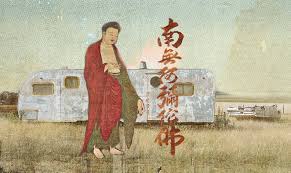
by Christopher Kakuyo Leibow (Kakuyo Sensei)
Welcome, friends.
The title of my Dharma talk is Ordinary Awakening. The two words seem odd together. I think there is this idea, especially among Western Buddhists, that awakening is something extraordinary, the destination at the end of an arduous journey of specific spiritual practices. Maybe. Maybe not.
Prince Shōtoku, a powerful regent who helped save ancient Japan from war and helped Buddhism grow there, wrote the following in Japan’s first constitution:
“Let us cease from wrath and refrain from angry looks. Nor let us be resentful when others differ from us. For all men have hearts, and each heart has its own leanings. Their right is our wrong, and our right is their wrong. We are not unquestionably sages, nor are they unquestionably fools. Both of us are simply ordinary men.”
Does this sound familiar?
As they say, history does not repeat itself. It just rhymes.
Prince Shōtoku understood something important: we are not different from one another. No one is inherently better or worse.
It’s this understanding that makes our community and tradition unique: we are just ordinary beings.
Shōtoku didn’t mean this as an insult or a lowering of the bar. He meant it as a release, freedom from the need, the hunger, to be someone special. It frees us from the idea that awakening belongs to someone else and, most importantly, gives us the freedom to simply be who we already are.
What does it mean to be who we already are?
That’s not as easy as it may sound. The vast majority of us have never been given, or taken, the right to be who we really are, even when we claimed we were. My whole life, I was more the stories of what or who other people wanted me to be. And for all the times I would declare my authenticity, it was just another layer of story.
Here’s an analogy: the Queen Mary, the old ocean liner that still sits in Long Beach harbor. When they decommissioned her and made her an attraction, one of the conditions was that they remove the massive engines so she could never sail again. When they removed the main smokestack, it crumbled. You see, after years at sea, the only thing holding it together was all the paint accumulated over the years. It was more paint than smokestack, just like me: more story than really me.
The analogy doesn’t totally work. I hope as I learn to come as I am, I don’t crumble into a pile of old paint.
Another way to look at it is through the teaching the Buddha called dependent arising. It’s pretty straightforward:
Everything exists because of everything else.
Because this is, that is.
Because this fades, that fades.
This is what is meant by non-self. Nothing exists on its own. We are all dependent on this or that, the endless conditions that move us along in our endless becoming.
I want you to really listen to what Nobuo Haneda says about this reality, this continual becoming. He says:
“When we truly see dependent arising in all things, we begin to understand how small our ‘knowing’ is.”
How small our knowing is… take a moment and let that sink in.
We know so little. But we act as if we are wise, knowing the motivations of others, knowing our own motivations, passing judgment on ourselves and others. We tend to make ourselves the hero of our story. But here is the thing: everything we are is because of the stream of life that has brought us here. We are all riding the currents of life that our countless ancestors set in motion, and countless actions that still ripple forward into our lives.
Here’s the reality of dependent arising. Nobuo Haneda goes on:
“We can name a few ancestors, maybe a handful, and then the faces dissolve into the dark. And yet their lives live in us. Their breath moves in our breath. The food we eat, the language we speak, the kindness that reached us, all came through unseen hands.”
The kindness that reaches us all comes through unseen hands. These are not just our direct ancestors, but everyone whose unseen hand has supported our very existence. Every day we are supported by those unseen hands we never think of.
From the sun and soil and photosynthesis that we take for granted. From the farmer who grows the food, the immigrant labor that gathers it, the trucker who delivers it. The road workers who made the freeway, the workers who made the cars. The person who made your clothes, the person who built the house you live in, the person who made the bed you sleep in, the person who made the pajamas you wear to bed, the person who wove the sheets and blankets that cover you at night… And you can do this for everything in your life.
And yet we think we pull ourselves up by our bootstraps. We think we know. As Shinran shared, even about himself: outwardly wise, inwardly foolish.
Our ancestors are alive in us, and for many of them, the dreams they dreamt are the dreams we live.
Everything we have is because of other people. Life is more gift than accomplishment. As Rev. Gyomay taught: there is no I without others.
Haneda goes on:
“When that realization sinks in, the shoulders drop, the heart bows.”
Shinran wrote,
“If the karmic cause prompts us, we will commit any kind of act.”
He wasn’t justifying poor behavior; he was pointing to how deeply we are woven into the web of causes and conditions. In other words, if put into the right situations, all of us are capable of great kindness and great cruelty.
To start seeing ourselves, we need to understand that we too are capable of being not just a victim but also a perpetrator. This is the beginning of truly understanding who we are. We are all ordinary beings.
And when seen through the lens of the Buddha’s teaching, this doesn’t take us down the path of shame or self-hatred, but of humility. We finally see how connected and limited we are.
Haneda Sensei once shared a story. He was sitting in a dentist’s chair, growing impatient with a young assistant who seemed clumsy and inattentive. Later, the dentist quietly explained that she was nearly deaf, struggling to read lips behind her mask.
In that moment, irritation turned to compassion. The world hadn’t changed. Only his seeing had. The surface melted, revealing the hidden conditions beneath.
As I’ve said before:
“Come as you are” is more than an invitation. There is something redemptive in being welcomed without having to become someone else, without having to prove ourselves worthy of belonging.
This is the heart of compassion: the willingness to see another as they are, angry, confused, passive, annoyingly positive, without judgment, without improvement. Just presence.
The Buddha taught there are not two worlds, not heaven and earth, not pure and impure, only two ways of seeing this one. Through clouded eyes, the world seems broken. Through clear eyes, it shines.
Haneda Sensei compared it to cataract surgery. Before, the world was dim and blurred. After, everything gleamed: the leaves, the hills, even the wrinkles in the mirror. He saw his bald head and laughed. That’s awakening, not escape, but clarity. The same world, seen new.
Shinran said, “In the moment before, life ends. In the moment after, life begins.”
It’s the death of the clinging self and the birth of the trusting self.
I spent much of my life afraid that I was going to be endlessly abandoned. We call them abandonment issues. I’m sure a few of you know all about it. I was so gripped by this fear that whenever I was in a relationship, I would worry about it every day. I would desperately look for ways to prevent it. Hence, I became a poet.
Then I read a line from Hafiz Helminski, something like: you can trust and be abandoned a thousand times a day, or you can surrender to trusting fully, and if abandoned, be abandoned once instead of a thousand times a day.
Those words changed everything for me.
In Shin Buddhism, it is called shinjin, the entrusting heart.
To trust enough to let go of knowing and to align with our true nature, with our conditioned existence. Not belief, not effort, just the quiet falling back into what has always carried us.
But what has carried us? In Pure Land Buddhism, there is a teaching of self-power and other-power. Self-power is everything that has to do with ego, and other-power is simple: it is everything else. Amida represents everything else that is continually supporting us. Our freedom is in a deep understanding of this important teaching.
When we live from that place, we no longer need another world. This one, with its dust and laughter, its grief and joy, is already the Pure Land.
The Weighing by Jane Hirshfield
The heart’s reasons
seen clearly,
even the hardest
will carry
its whip-marks and sadness
and must be forgiven.
As the river knows
there is no hurry,
we shall come to its end
with peace.
Hirshfield’s poem could have been spoken by Shinran himself: “The heart’s reasons, seen clearly.” The heart that sees its own scars must forgive itself.
In a previous Dharma talk, I shared this:
“Our happiness is not outside ourselves; awakening is not awakening to something outside ourselves but to something within. In an absolute sense, everything is already awake. It’s just that each of us must awaken from our dreams and stories.”
So maybe being ordinary is the highest calling of all, ordinary enough to see things as they are, ordinary enough to bow at our unknowing.
It is like driving home at night in the rain, each color of the streetlights dancing in the water running down your windows. Each reflection trembling, perfect in its impermanence.
We are learning that awakening doesn’t lift us out of the ordinary. It opens our eyes to the luminous texture of the everyday.
This is the Dharma of humble seeing, of gratitude in motion, the practice of ordinary awakening.
Namu Amida Butsu

