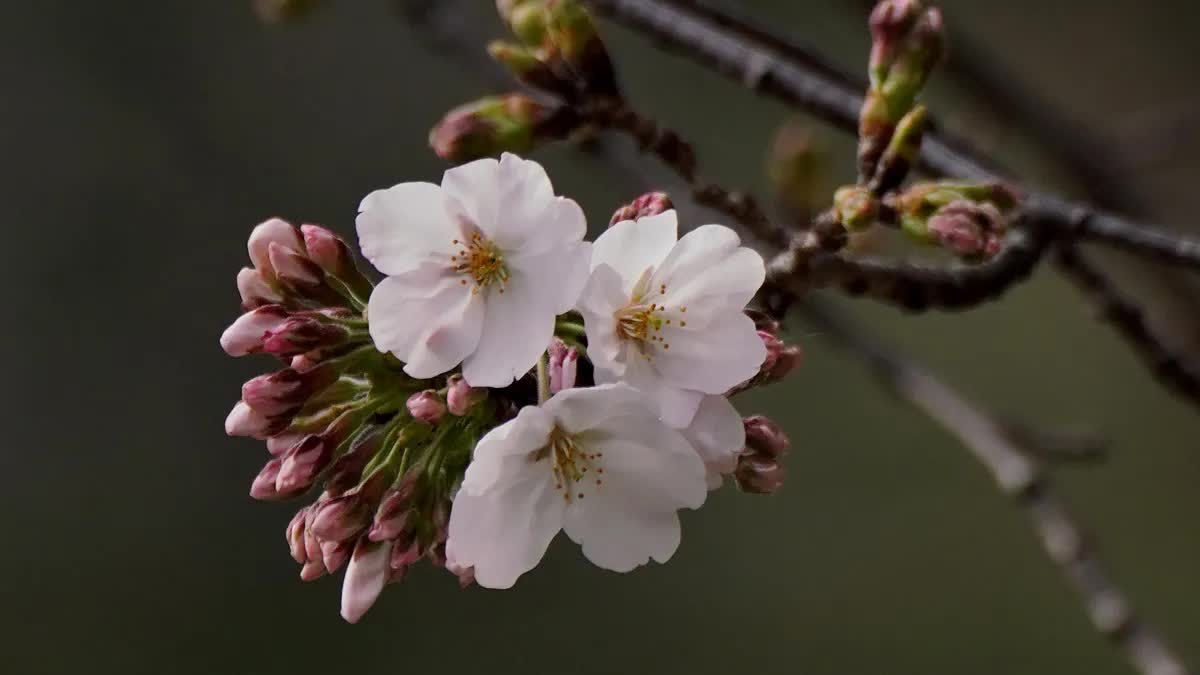
Good morning. So the title of this dharma talk is actually a quote from Rainer Maria Rilke:
“Is not impermanence the very fragrance of our days?”
I love this quote because it reminds me that our impermanence is what gives life meaning. The fleeting, unknowable, ephemeral, impermanent nature of being alive can bring heartbreak and suffering, and it does, but it is also what makes life meaningful and precious. Like a fragrance, impermanence is a subtle but present element that shapes our experiences, encouraging us to live more fully and appreciatively in the present moment
At least, this is what I have been trying to remind myself of this week.
I had a different dharma talk planned for today, but then, as life does, everything changed. Or, rather, death changed everything. Death, which is the inevitable thread woven through this whole living thing.
So, needless to say, I have been sitting with the truth of impermanence very intimately this week.
A week ago today, I learned that my beloved stepdad, Tom, passed away. Since then, I’ve been moving through waves of grief–grief mixed with love, nostalgia, gratitude, sadness, and even relief. Relief because he had been suffering from a progressive form of Lewy-body dementia these last years, and the man we loved had been slowly slipping out of view for a while.
For the last five or so years of his life, the progression of his dementia raised all kinds of existential questions in me about identity, memory, selfhood, and what it means to be alive. I have a tendency to get captivated by those kinds of questions, but as the Buddha taught–speculative questions that don’t lead to liberation only entangle us further in suffering. In The Shorter Discourse to Māluṅkyaputta, the Buddha gently redirects Māluṅkyaputta away from metaphysical speculation and back toward practice, toward awareness, toward the lived truth of our experience, toward the four noble truths.
In the book Everyday Suchness, Reverend Gyomay Kubose describes this well:
“Buddha did not speculate on that which is unknowable, such as an unknowable beginning or end. There is no beginning or end in eternity. He did not conceptualize eternity. Eternity is now. The present moment includes the eternal past and the eternal future. It is the eternal-present. Buddha was interested in the present.”
This teaching brings me back to the heart of life, and to the reality unfolding right in front of me.
In grieving my step-dad this week, I’ve noticed my mind wanting to cling to certain versions of him–to a certain “self” I conjured him to be. Reminiscing, telling stories, remembering his tenderness, his intelligence, his humor–these things have brought comfort and connection in a difficult time, of course. Yet I’ve also seen how holding too tightly to a fixed image of him creates more suffering, at least for me. When I cling to a story of him as unchanging, the loss feels more absolute. And it isn’t true. It isn’t in line with the truth of his life, or the truth of anyone’s life. The truth of life is impermanence, the truth of life is continually unfolding and becoming–like the life cycle of a fruit tree.
Nobuo Haneda puts it beautifully in Dharma Breeze:
“The only Dharma (truth) that Buddhism teaches us is the truth of impermanence. The truth of impermanence is the freshness of life, or creativeness of life. When this truth starts to permeate us and we start to embody this truth, we become seekers.”
So what does this truth teach us, here, in our everyday lives?
For me, the truth of impermanence teaches that this moment is all that truly exists. It reminds me that how we relate–to each other, to the world, to our own experience–is more important than having spiritual or philosophical certainty. In this utterly unrepeatable life, all we truly have are passing moments with one another.
As Rachel Naomi Remen writes,
“The way we deal with loss shapes our capacity to be present to life more than anything else. The way we protect ourselves from loss may be the way in which we distance ourselves from life.”
In the past, I dealt with loss by trying to have or find answers. I wanted a clear belief system, certainties to protect me from the unknown. But honestly, that way of thinking became a trap of duality. For me, it was deeply limiting. It cut me off from others, especially those who saw things differently. It cut me off, even, from my own heart, from my own life.
This time, I am trying to take a different approach. I’m allowing myself to not know. I’m letting multiple possibilities coexist. I’m surrendering–not in defeat, but in humility–to the mystery of all of this. And in that surrender, what has been arising for me, underneath the layers of grief, is gratitude and a sense of spaciousness around my experience of grief.
I’m reminded of this quote by Adyashanti: “Right now you can allow yourself to experience a very simple sense of not knowing–not knowing what or who you are, not knowing what this moment is, not knowing anything. If you give yourself this gift of not knowing and you follow it, a vast spaciousness and mysterious openness dawns within you. Relaxing into not knowing is almost like surrendering into a big, comfortable chair; you just fall into a field of possibility.”
This week, I’ve felt that spaciousness in unexpected moments, and it has helped me accept life as it is, continually unfolding.
In loosening my grip on selfhood and on fixed truths, I’ve been able to allow people (including myself), and life, to contain multitudes, to continually unfold, to become anew.
As Gyomay Kubose writes: “There is no ‘I’ as such apart from others. Life is a continuous becoming. It is all relative existence.”
Another quote I love that reveals this truth is by Sanober Khan who said:
“If I began to draw myself away from you, we’d still be like two mixed colors of paint, impossible to separate.”
The truth of impermanence then naturally leads me to a sense of our inherent interdependence. Those we love, and those we lose, are not gone. They live in us. They live on through us. My stepdad lives in me. I can feel it. I am because he was. In ways I’ll never be able to catalog or fully understand–his life and his love is a thread that runs through me.
And so impermanence doesn’t just point to loss…it points to preciousness. It points to interdependence. It points to the shimmering, ever-changing beauty of this life.
As Gyomay Kubose writes:
“It is the Buddha’s teaching that all things are in constant change. The truth of life is becoming; in fact, everything is becoming. The truth and beauty of nature are in this change.”
I want to share a poem I wrote a few years ago that shares this theme, and reminds me of the preciousness life:
Sacred Secret—
A psychic gave me a coin, she says
it holds the secret to life, but all it reads is:
       you are dying

I hold it in my hand, palm it in my pocket
trying to understand this side
of life, but I was looking for answers
and this just gave me more questions!

what did she mean?
why am I still holding this?
where are the answers?

as I toss the coin into a fountain
of youth, wishing for another side
to life, I notice the coin is shining
sunlight catching my eye,
now it says:
             you are living

 my fate turning on a dime,
my eyes seeing
the sacred light of life
for the first time
I don’t have all the answers, or even any answers, really, but thankfully that is not what I am searching for anymore. I seek to be a humble student of the way, and this week, that means honoring the truth of impermanence, trusting the power of compassionate presence, and living the evolving beauty of interdependence.
In practice, it means hugging those I love a little bit tighter, it means turning with compassionate awareness to each unrepeatable moment, it means listening wholeheartedly to myself and to others, while holding the profound truth of our impermanence.
I want to end with a story from Dharma Breeze by Nobuo Haneda:
“A few days before Shakyamuni passed away, he was traveling toward Kushinagara where he would die. When he looked at the evening sky, he said to Ananda, “Ananda, this world is so beautiful, so wonderful.” When Shakyamuni said those words, he certainly knew that this world had not only all kinds of joy and happiness but also all kinds of suffering and tragedy. But, he said, “This world is wonderful” in spite of all the suffering and tragedy. No, to use the expression “in spite of all the suffering and tragedy” here is not appropriate. It would be more correct to say that he said, “This world is wonderful” precisely because of all the suffering and tragedy.”
There is beauty in impermanence, there is preciousness in our moment to moment experience. We are all of the nature to change, to become anew, to pass on. Perhaps this truth can help us to cultivate a deeper appreciation of our lives, and of one another.
Namu Amida Butsu
By Laura Bennett
 Everyday Nembutsu