by Gwen Juvenal
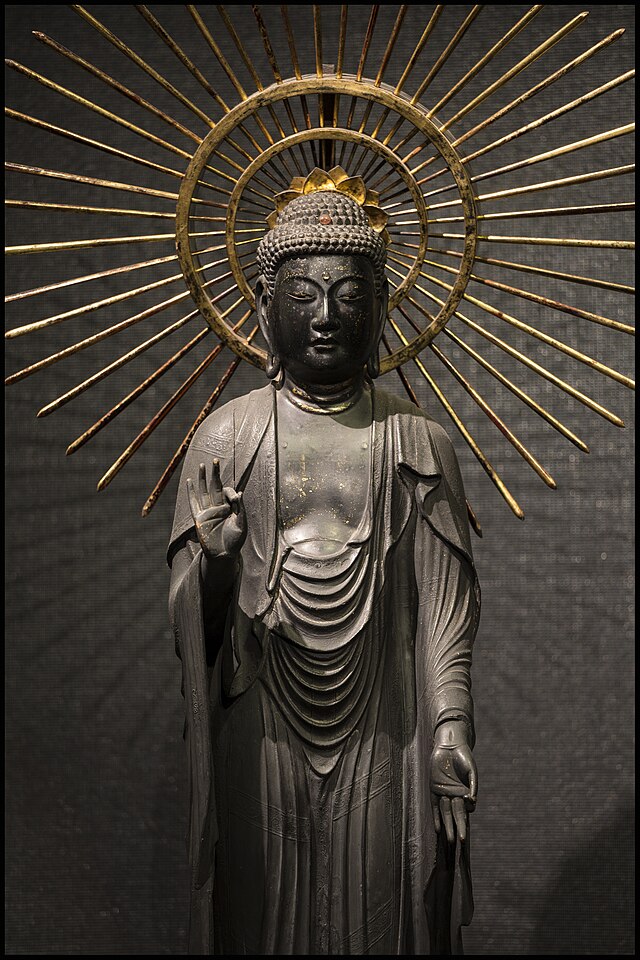
The phrase Namu Amida Butsu, or the nembutsu, is central to our practice at the Buddhist Fellowship. We translate it as “Come as you are.” This simple invitation holds immense depth. It encourages us to set down the weight of who we think we are, or who we must be, and rest in infinite compassion.
In River of Fire, River of Water, Taitetsu Unno writes, “In ordinary language, namu-amida-butsu is saying, ‘I have arrived. I have come home.’ Thus, Shin Buddhists call this the truly settled state.” Both this and our “Come as you are” translation guide us to rely on Amida Buddha’s boundless compassion—not as a reward, but as a constant presence. Acceptance, love, and wisdom are not earned; they simply are. I’ve come to love that phrase: the truly settled state. It describes what I feel when our services begin. I return to my breath, to presence—a space where I can rest.
You might wonder: why not just say “Welcome home” or “Come as you are,” and leave the chant behind? I see those phrases as the fruit—the blossom that comes from devotion, chanting, and practice. They are the gift of the nembutsu, not a replacement for it.
I want to highlight three distinct yet unified dimensions in the phrase Namu Amida Butsu:
First, Namu—the bowing of the foolish self: the part of us still caught in delusion, greed, or fear. It is the acknowledgment of suffering, our limited view, and the willingness to offer it up.
Second, Amida—infinite light and life: unconditional compassion that embraces us, never abandoning us even in our fear or ignorance. The cosmic vow of belonging.
Third, Butsu—Buddha: awakened nature, the recognition that even in darkness, light is present.
Together, the phrase is a dynamic dance or alchemy: the brokenness and longing of the self (Namu) met and embraced by the boundless love of Amida, which opens us to awakening (Butsu)—the realization of no separation. The chant itself doesn’t simply name two sides; it trains us in the middle—the living compassion that transcends and includes both.
Sometimes, when I chant Namu Amida Butsu, I’m like a child crying out. Sometimes I am the voice of Amida, offering comfort and reminding myself and others what home is. At other times, I become the boundless space that holds it all. Sometimes, I feel as if I am all of it at once.
In River of Fire, River of Water, Unno compares the experience of Namu Amida Butsu to that of a mother responding to her child in the night. I’d like to expand on the story he shares.
It’s bedtime. The house is dark, and the child calls out—afraid of the “monsters in their room.” The mother comes quietly and turns on the light. “There’s nothing here,” she says gently. “There are no monsters.” The child looks around and sees it is true. The room is just the room. Comforted, the child settles, and the mother turns off the light and leaves. But minutes later, the cry rises even louder: “Mommy! Mommy!”
This time, the mother doesn’t turn on the light. Unafraid of the dark, she enters the room and makes her way to her child’s bedside. She sits, softly wraps her arms around them, and whispers, “All is well. I am here.” She wipes away their tears and holds them close. “Listen to my heart,” she says. The child rests their head against her warmth, listening to the steady beat. Their breath slows. Their eyes begin to close.
When she knows the child is content again, the mother stays a moment longer. From this angle—curled beside the child—she notices what the child had mistaken for monsters: shifting shadows cast by moonlight filtering through the trees. She stirs the child gently. “Don’t be afraid,” she says softly. “Let’s look together.”
Taking the child’s hand, she leads them to the window. She points to the full moon, the swaying branches, and how the light bends to make shadows. Lifting her hand into the light, she shows where its shadow lands on the wall. “This is how it happens,” she says. The fear begins to ease; curiosity awakens. Together, they begin to play—walking through the room, watching how the shadows shift and change. They become monsters, trees, dragons, mountains. “What do you see now?” she asks, again and again, as they move and look from different perspectives. What once felt like a nightmare becomes a kind of magic. Laughter fills the room; imagination opens.
Eventually, the child grows sleepy. As the mother tucks them in again, the child suddenly sits up. “Wait, Mommy! What about my dreams? When I’m there, sometimes I get scared again. Sometimes the monsters come. Can you be with me when I dream?” “Yes, of course. I am always there,” she says. “Simply call my name and listen deeply. There is nowhere you go that I do not go. The moon, the stars, the trees, and the wind will tell you this truth—if you listen carefully.” The child smiles and sighs, glancing around their now “safe” room. “I am always home?” they ask, eyes lighting up. “Yes,” she whispers, kissing their forehead as their eyes begin to close. “You are always home. You are simply dreaming.”
That entire sequence is Namu Amida Butsu—the call, the response, the transformation of fear and suffering into wisdom and play. The wisdom lies not in rejecting darkness but in learning to see what casts the shadow, and how everything is related and connected.
I’d love for us to explore three views within this story and invite you to inhabit each briefly with me: the wide view—the Buddha, holding the whole field; the one who calls—the child, the movement that opens; and Amida—infinite wisdom and compassion.
First, zoom out from this room. Picture the night sky, the moon, the trees, the window, the bed, the child. See how all the elements rest together; how everything belongs to the whole. Notice shapes, details, and relationships you might miss when you’re inside them. From this view, you hear the call—it comes from within. Feel yourself being drawn down into the room inside you, pulled…
Now, become the one who calls out. Feel the sheets, hear the sounds of the night, notice the urge to call. What is the call inside you right now? Allow it to be whatever it is. It doesn’t need to be pretty or explained—just let it be. Maybe you voice aloud: “I suffer. Please help me.” Notice what it feels like to give this space.
Now, step into the view of the one who answers. Become Amida. You might say aloud: “I am Amida. I am compassion. I answer the call.” As Amida, how do you see the caller? What is your relationship with them? What does Amida see that the child could not? Notice what integrates naturally inside this presence—the call, the wide view, the whole scene. Integration is not a separate step; it happens in the feeling of receiving and being received. True connection and wholeness arise here.
Where is the truly settled state for you right now? Try saying these phrases, silently or aloud, pausing between each to feel them:
I am the call.
I am the answer.
I am the moonlight.
I am the room.
I am the one who is afraid, and I am the one who comforts.
I am the child, and I am Amida.
I am home.
What does the truly settled state feel like to you? How do you open that state for yourself?
For me, the chant Namu Amida Butsu is not a mechanical cure. It is a way of remembering the body of home—learning again how to call across the dark, how to receive an answer, and how to rest in wholeness.
When I feel pain or suffering and call with this awareness, I find the courage to be with the phantoms—the shadows I so often carry. Here, they do not possess me; they offer me the adventure of awakening that I came for.
So I return to the phrase: Namu Amida Butsu. For the frightened child who dares to call out. Namu Amida Butsu. For the mother sitting in the dark—the one who dares to respond. Namu Amida Butsu. For the radiance that never left through all of it.
Namu Amida Butsu—as I feel myself settle into a warm bed and hear the phrase, “You are always home.”
 Everyday Nembutsu