By Kelly Branan
When we say together, Namu Amida Butsu, we are not reciting a password. We’re not trying to pass some hidden test. We’re responding to an invitation—simple, yet profound: “Come as you are.” That’s it. No prerequisites. No spiritual résumé. No checklist of virtues. Just you, here, now, with all your baggage, all your beauty, all your contradictions.
I want to share what it was like for me when I first encountered this phrase: Namu Amida Butsu. What struck me was not the foreignness of the words, but the warmth. It felt like an open door on a cold night. Like someone saying, “You’re welcome here. You don’t have to change first.”
Shunryu Suzuki once said, “Each of you is perfect the way you are. And you could use a little improvement.” That paradox always makes me smile. It’s exactly how the nembutsu feels. We are already held, already embraced. And yet, of course, there’s always unfolding, always growth.
Now, I’ll be honest—this was not the kind of religion I grew up with. I was raised LDS, and there, I often felt like I was living in a kind of spiritual waiting room. The very best things—the full vision of God, the answers to the deepest questions, the moment of true belonging—were always described as coming later. In the next life. After judgment. If I proved myself worthy.
Even as a child, I carried that sense of postponement. It was a little like the marshmallow test—maybe you’ve heard of it? The idea that if you can wait, if you can resist the marshmallow now, you’ll get more marshmallows later.
That’s how faith felt to me: “Don’t enjoy too much now. Don’t be too comfortable now. The real reward is waiting later.”
Now, there’s wisdom in self-restraint. Discipline matters. But there’s also something heartbreaking about constantly deferring joy. As if life itself were just a rehearsal.
Pure Land Buddhism startled me awake. Because here, the Buddha isn’t holding out on us. The Buddha isn’t testing our patience. The Buddha isn’t some distant being waiting behind a veil. The Buddha is already here. Already embracing. Already near. The nembutsu is not a practice we do, but a gift we receive.
When we say Namu Amida Butsu, we’re not trying to reach out to some faraway figure. We’re letting ourselves be reached. It’s a moment of awakening, a moment of clarity, when we realize we are already being held in compassion.
And what a radical thought: everywhere and in everything, a Buddha. That line still stops me in my tracks. Because when I was younger, I thought the sacred was only in temples. Only in scriptures. Only in the lives of prophets.
But here, in this tradition, I learn: the sacred is in clouds. In my cat. In the pile of dirty dishes. In fatigue and laughter, in grief and in love.
Thích Nhất Hạnh once said, “The miracle is not to walk on water. The miracle is to walk on the green earth, feeling truly alive.”
The Buddha-nature is not hiding in some far-off heaven. It’s right here. This very step. This very breath.
Back when I was LDS, there was a song that always moved me deeply—“Face to Face” by Kenneth Cope. It spoke of longing for the day I would finally meet Jesus, look him in the eyes, and thank him for carrying me through life.
I cried more than once imagining that scene: kneeling at his feet, overwhelmed with gratitude and awe. That longing hasn’t left me. But Buddhism has given me a new way of seeing it.
That “face-to-face” moment I longed for? It’s already happening. It happens in the smile of a stranger. It happens in the rhythm of the rain. It happens even in the face of someone I struggle to love. And maybe most miraculously, it happens when I look in the mirror and soften toward my own weary reflection.
We don’t have to wait for the next life to meet the sacred. It’s not hidden behind a veil. It’s the very fabric of this moment—if we let ourselves notice.
Dōgen, the great Zen teacher, once wrote, “If you cannot find the truth right where you are, where else do you expect to find it?”
The Buddha is not somewhere else. Not testing us. Not withholding. The Buddha is here. In this. In you. In me.
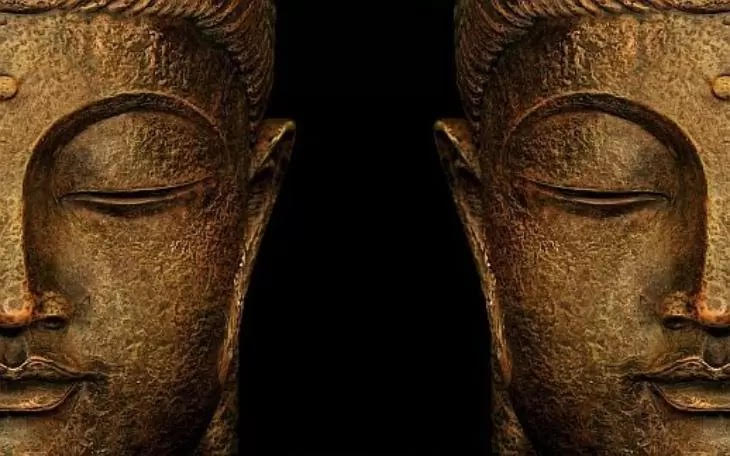
So what does it mean to live this way? For me, it means meeting things face to face.
There’s this image I love: the Buddha sitting under the Bodhi tree, finally opening his eyes and seeing the morning star. And in that simple sight—enlightenment. Not a thunderbolt. Not a divine voice booming from the sky. Just… a star.
Sometimes I wonder: how many “morning stars” have I missed while waiting for something bigger? How many times have I dismissed the sacred because it wasn’t dramatic enough?
These days, I try, imperfectly, haltingly, to meet each thing as it is. Not as an obstacle. Not as a test. Not as something to endure until the “real” life comes along. But as sacred. As already carrying the face of the Buddha. And this changes everything.
Because if the Buddha is in the barking dog, the unwashed laundry, the tense meeting, the blooming daffodil, then my life is not a waiting room. This is already the Pure Land unfolding. Here. Now. Not perfect. Not painless. But holy, because it is real.
So I no longer wait for a face-to-face encounter in some far-off paradise. I try to meet you here. And myself. And the wind. And my doubts. And the sound of chanting.
Namu Amida Butsu is not just a mantra. It’s the gentle knocking at the door of the present moment. It’s the voice that says: “You don’t have to wait anymore. You’re already being held.” And maybe, in that holding, we can finally look each thing in the eye and say: “I see you. I’m here too.”
 Everyday Nembutsu