Nature as a Teacher of the Dharma
We get to spend our annual retreat in such a beautiful place—one that has quickly become one of my favorites. We listen to Dharma talks and attend workshops, we have time to meditate, and we enjoy the beautiful altars. But we can also learn so much by simply tuning in to our surroundings.
I want to share some things I’ve learned from nature in my own life and during past retreats, and also reflect on the ways nature has served as a teacher within Buddhism and even for the Buddha himself.
A First Encounter with the Stream
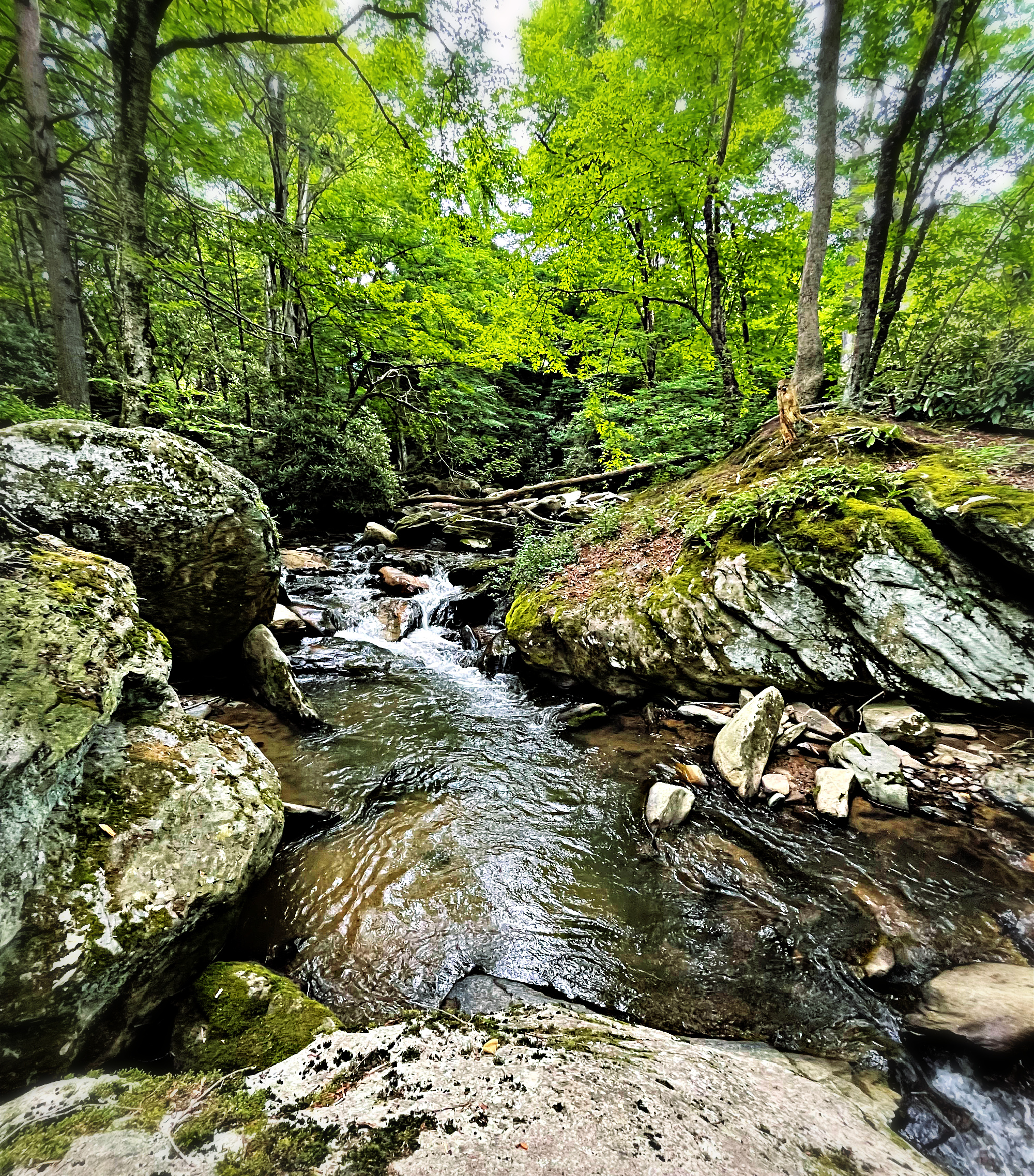
Two years ago, during my first retreat, I wandered up the property and followed the stream. I’ve always found rivers to be peaceful and soothing. Maybe I have some affinity for them because, as nearly everyone I’ve ever met likes to mention, Río means “river” in Spanish.
I had never written a poem before, but as I sat by the stream, I felt like giving it a shot. I worked on it for the rest of the retreat until it felt like what I imagined a poem should sound like. Here it is:
How long does a river last?
Is it the water or the path?
Always changing, ever the same,
The song of the river is what relieves my pain.
Surging in spring, faltering by fall,
Ready to be reborn, in a new way, in the same place.
Shape and form change, no matter the terrain,
A conduit of motion, carrying mud, rocks, and rain.
Transparent and unattached,
Not defined by source or destination,
A river lasts forever with constant transformation.
That poem was my attempt to capture what is so captivating to me about rivers. Over the years, they’ve become what Rev. Koyo Kubose called a SPOT—a “Special Place of Tranquility.” A place where I go to meditate, to think, and to step away from the busyness of daily life. In addition to this poem, I’ve begun compiling a list of lessons I’ve learned from rivers. In many ways, rivers have become Bodhisattva teachers for me.
Lessons from the River
Rivers remind me to go at a natural pace.
I often rush. I like to get things done quickly and efficiently—which usually means I’m stressed and not enjoying the process. It’s hard for me to slow down, smell the roses, and not get consumed by what’s next on my to-do list.
Rivers, however, don’t all go at the same pace, and they certainly aren’t always slow. They can be fast and roaring, even violent, or almost imperceptibly slow and silent. Their pace depends on the slope, the flow of water, and the obstacles in their path. It’s not a choice the river makes—it simply flows as it must.
This teaches me that slowing down can be just as important as moving quickly, and that there is a natural time for both.
Rivers remind me of the importance of constant motion.
When rivers become stagnant, life struggles. Bacteria and fungi overgrow and organisms suffer. The motion of a river keeps it alive and healthy. In the same way, we are always changing. Change can be scary or unwanted, but it has an important function in our lives—it helps us grow and keeps us aligned with the natural rhythm of impermanence.
Rivers flow along the path of least resistance, yet still transform their path.
Our practice manual, in the section Letting Go to Freedom, reads:
Let us practice letting go.
Let us be like water without resistance.
Let go of all pretenses, scheming,
and our need to control the uncontrollable.
Water doesn’t know what terrain lies ahead—it simply flows. And yet, over time, it carves valleys and canyons.
I, however, often struggle with giving up control. I resist life’s steep cliffs, pouring energy into avoiding the inevitable, only to cause myself more suffering. The river teaches me to accept circumstances as they are.
Acceptance, though, does not mean inaction. It means engaging fully with what is in front of me, putting energy into the present moment rather than avoiding it. By doing so, I slowly carve new pathways in my mind and habits, preparing me to face the challenges that will surely come again.
Streams of Consciousness
Last year, as I returned from visiting the stream, my fellow Kalyana Mitra Steve called me over. He broke noble silence just a little, leaned over, and whispered, “Stream of consciousness.”
That phrase struck me like a kōan. The mind, like a river, is always flowing. Thoughts drift by like leaves on water. Sometimes we plunge in, immersed in plans, memories, fears, and desires. But we can also step back onto the bank, breathe, and watch them flow by.
Those thoughts are not who we are. They may be useful, or not; necessary to engage with, or not. But like the stream, the flow is always there, offering us fresh water when we are ready.
Nature Beyond Words
Our practice manual says in the section Face to Face:
Flowers, dogs, trees, sky, clouds, earth, you, me.
A flower blooms, a dog barks, and the wind blows—
Enlightenment beyond speech, beyond silence.
The last line stands out to me: Enlightenment beyond speech, beyond silence. Not everything about the Dharma can be spoken or written.
At a past retreat, Christopher Sensei said, “When you begin to observe noble silence, pay attention to the silence that is already there.”
Why do we make time for silence? Why not fill the schedule with more classes, workshops, and words? Because silence itself is an invitation to the Dharma—the Dharma that is already present in nature and waiting for us to notice.
This summer, I was sitting by a reservoir watching sunlight glimmer across the choppy surface. My life felt equally unsettled at the time. Out of that moment came this haiku:
Turbulent water,
Expressing waves within waves,
Still reflects the sun.
It didn’t matter that the water wasn’t smooth. The broken reflections of light were beautiful in their own way. The teaching was clear: even in turbulence, beauty shines. Even in confusion or self-doubt, compassion remains possible.
Teachings from Rev. Gyomay Kubose
Much of our fellowship’s inspiration comes from the teachings of Rev. Gyomay Kubose, especially his book Everyday Suchness. He wrote:
“The sun is not conscious of giving benefit.
It has never realized any altruistic motives,
nor thought, ‘I am shining.’
It simply shines.
Life is like that, too.”
What I love about this is that the sun does not try to teach us anything. It simply is what it is, and the teaching comes through our observation. The sun doesn’t shine for us—and yet, without it, we would not survive.
Rev. Kubose’s point is that perhaps the best way to help others is to live authentically, to shine in our own way. Not because we intend to be useful, but because that is our true nature.
He also speaks of interdependence:
“Life is one; this is the beauty in life.
Unity in diversity; this is the beauty in nature…
Because all life is one, we respect every life.
When we realize the reality of our interdependence,
we cannot help becoming harmonious, peaceful, and appreciative of one another and of all things.”
Nothing exists alone. Just as a tree cannot be reduced only to trunk, roots, or leaves, we too are inseparable from all that sustains us. The Amitabha Chant reminds us:
“The sun’s light, the moon’s radiance,
the flowers blooming, the song of the bird…
I receive everything.
The heavens and earth and all of humankind are supporting me—
and because of this I am alive.”
This is gratitude for interdependence, for the fact that our very existence depends on the whole.
The Buddha and the Earth
The Buddha himself found his awakening in communion with nature. After years of training, he sat beneath the Bodhi tree and vowed not to rise until he reached enlightenment.
When Mara tempted him with distractions and doubts, the Buddha did not argue or call to the heavens. Instead, he touched the Earth, asking it to bear witness. The ground confirmed him.
In that moment, the Buddha realized he was not separate—from the earth beneath him, from the stars above, from the whole of life. Enlightenment was inseparable from nature itself.
Great Earth Bodhisattva
Great Earth Bodhisattva
To close, I want to share one final passage from our practice manual, written by Christopher Sensei:
Here and now, we acknowledge the compassion of you,
our Great Mother Earth Bodhisattva.
Here and now we joyfully acknowledge and receive
all that you give to us freely—
the air, the water, the soil that gives us life.
From the lone bee to your great oceans,
we acknowledge your wonderful gifts.
Together we vow to practice gratitude,
Great Mother Earth Bodhisattva,
and vow to protect you—
in mind, word, and deed—
that you may call us Witness, Healers, Defenders, Friends.
May it be so.
Listen to the call of the Dharma that is taught in all things. May we each find intimate moments with nature, discovering teachers everywhere—just as I have found a teacher in the river.
Namu Amida Butsu.
 Everyday Nembutsu