Driving Dharma: Everyday Buddhism – Dharma talk given Jan 2023
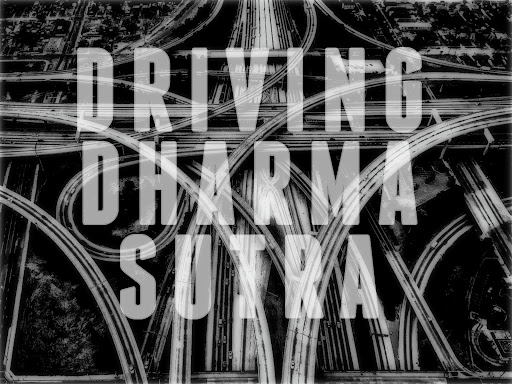
Today, I want to share some thoughts on a very contemporary form of dharma, which I call driving dharma. This is a relatively modern form of practice, being ushered in shortly after the dawn of the 20th century, and is one whose sutras have yet to be written. Well, sort of, I have come across an excerpt of a little-known sutra. It appears that the Buddha, in his great compassion, was concerned about the suffering of drivers. It is just an excerpt, but this is what I found.
The Dharma Highway Sutra
Not long ago
When many were gathered
at the cloverleaf, where the I80 and the I15 meet
Many of the followers of the Buddha
were gathered near an open field
next to freeways.
When the Buddha appeared
he had come to address the assembly
of lay followers and drivers of all ages.
The awakened sat in full lotus and began
I heard these words of the Buddha.
“Drivers”
And the drivers replied, “Venerable Lord.”
The Buddha’s face softened,
and he emitted a ray of light
from the tuft between his eyebrows
“Oh, Drivers,
my concern for you and all living beings
is boundless, and thus, I have come here,
Where these two rivers meet
The I-15 and the I-80
and their tributaries
I have come here because of the suffering
that pervades this river and its tributaries,
He continues,
Since beginningless time, all sentient beings have
had all sorts of delusions, like a disoriented person
who has lost his sense of direction.
Who is held hostage to strong emotions
of failed expectation, who argues with reality daily,
especially during their morning and evening commutes.
Even the virtuous followers can find themselves overcome
by blind passion when someone invades their lane of traffic
or crowds their rear bumper at high speeds.
Even the wise can be blind-sided by anger
at a slow conveyance in the passing lane.
Do I not speak the truth?
And the drivers reply – Yes, Awakened One.
Unfortunately, most of the remaining sutra was water and coffee damaged and lost in the ravages of time.
You ask, a Sutra about Driving?
And my reply is if only. I sure could use one.
My mentor, Rev Gyomay Kubose Sensei, and his son Koyo Kubose Sensei were all about what they called Everyday Buddhism – a Buddhism that engaged with the everyday life of regular people with everyday challenges and concerns – a Buddhism that applied to ordinary life – Because ordinary life is as the Zen Master Nanquan, The Way. Not much can be more ordinary to modern man than driving.
So if the Way is ordinary life, it is not far from the proposition that driving, part of ordinary life, is the Way. It is the Way. How and the hell? Shit, I’m screwed.
First, I want to share a line from a poem by the Venerable Robina Curtin. She is a Tibetan Buddhist nun in Australia, and I love the matter-of-factness of her lines.
“We’re all mentally ill / We’re all delusional/ We’re all junkies / It’s just a matter of degree. “
I like how she embraces certain negative labels and says, Waitt, hold on. You think that is not you…come on!”
These are the labels we use for other people, not for ourselves. We use them to discount and dismiss their experience because they are not like us. It’s all a way for us to avoid really looking at ourselves. She calls it as it is: “You are delusional!” I think most of us would agree that we are delusional in a “not yet awakened way” but not “actually delusional” or in a “literally delusional” way, but is that true?
I appreciate Shinran Shonin and adapted one of his poems to these lines that used to be in our practice manual.
Blinded by our delusion, anger, and greed, we cannot see the brilliant light that embraces us – The Great compassion never tires, always casting its boundless light upon us, just as we are, always.
Let’s start with a question –
Q: What do we call someone who is out of touch with reality or who doesn’t accept reality as it is?
Q: Would you consider yourself delusional? It’s not something we are usually asked.
For our purpose here, we will define delusional as someone who argues with reality. I like the Way Noah Ma-yo Sensei puts it: We “argue with reality.” What does that look like? We argue with reality when we want something to be different from what it is.
We are delusional because we ” want reality to be different than it is.” It’s even more than just wanting; we also scheme, invent strategies, and create convoluted stories, all so we do not have to accept reality as it is.
Let me share an everyday experience that helped me see this and is part of a book I have dabbled with for years. It is titled Dharma Highways: How Driving Teaches Us the Way…….
Every morning when I drive to work, as it does every day, the flow of traffic constantly changes. It slows down and speeds up, always in a state of flux because of a myriad of causes and conditions. This is the very nature of traffic.
When traffic stops moving, it ceases to be traffic and becomes parking.
That aside, here I am driving to work or home from work like I do every day, and the reality that I want, the reality that I EXPECT, is the following:
· no red lights,
· goodly speeds,
· graceful lane changes,
· blinkers, yes blinkers.
I expect traffic to be light and, if heavy, still moving efficiently.
But what happens when these expectations are dashed after the first right-hand turn? Anger? rage? We, I mean, I become frustrated, my pulse races and my vision narrows. I am assigning all kinds of character traits to people I don’t know. I transform into an enemy, one of Mara’s henchmen. I have also noticed that since the pandemic, it has gotten worse. I even noticed during the week that as I was preparing this dharma talk, as it says in the Driving Sutra,
“Even the virtuous (semi-virtuous in my case) follower can find themselves overcome by blind passions when someone invades their lane of traffic or crowds their rear bumper at high speeds.
Even the wise can be blind-sided by anger at a slow conveyance
in the passing lane.”
The chanting I was doing moments before was forgotten, replaced with the less skillful chant – Seriously?!
I need to remember that I have a Buddha on the back window of my truck.
Overcome by blind passions, we start, well, I starts to drive aggressively, tailgating the offending car in front of me, all because she moved into my lane and caused me to touch my brakes. How dare she. How rude, how disrespectful,
Namu Amida Butsu.
Of course, I did not notice the bumper sticker placed lovingly on the driver’s side of the bumper by her special needs granddaughter that reads, “World’s Greatest Grandma.” Then, in a flash, I realize,
“holy crap, I’m delusional!”
In a very real way, I am not seeing reality as it is I am suffering because I want “reality to be different from its.”
It really is lunacy to suffer so greatly in the ebb and flow of traffic; it’s traffic ebbs and flows. Duh.
And yet, even while I have been working on this talk – arg!
Incidents like these make me think of how many other places in our lives we are delusional: our relationships, our jobs, and our expectations of ourselves.
One of the greatest teachings I have found in the dharma and from Gyomay Sensei is that acceptance is transcendence. We suffer because we are unwilling to accept reality as it is and are willing to dive right into the depths of dukkha because we want so badly to believe we have some control over life. I would rather suffer and stay deluded. And yet, to be free, I have to acknowledge that there is nothing I can do to change reality.
That reminds me of Hiroyuki Itsuki’s mantra, which keeps him sane, in his book Tariki: ” There is nothing I can do about the natural ebb and flow.”
This is a great mantra when stuck in traffic: “There is nothing I can do about the natural ebb and flow of traffic.”
Here is something that I rarely think of when I get behind the wheel. Mindfulness practice.
Rev Koyo Sensei talks about it in his book Bright Dawn – Everyday Spirituality, and so do others.
If you think about it, we can see it as an immediate opportunity to practice the dharma each time we get behind the wheel. I appreciate this from an article by Trucker Paul Conrad in the Winter 2002 Tricycle.
Think about it. You’re hurtling down the highway inside a three-thousand-pound metal box, surrounded by other speeding metal boxes and immovable objects…
That puts it into perspective, but we never really think about it that Way, do we? Driving can be dangerous. Most of our other daily activities have little or no danger of serious harm compared to driving, and yet we do it so mindlessly or reactively.
He goes on to write.
Driving provides continual opportunities for us to wake up, to be mindful. There is no other daily activity for which moment-to-moment awareness is so important or the consequences of inattention so immediate and potentially catastrophic.
My practice is the practice of acceptance. I can accept the ebb and flow of traffic and simply observe how it works, similar to my own mind. Traffic has become a metaphor for my own thoughts. When I start my usual driving chant of “Seriously!”
I take a breath and say ebb and flow, ebb and flow. I have noticed that whenever I do this, I become more aware of the unnoticed kindness of strangers who let me in, the person in the car next to me crying, or the kids in the back seat laughing and making faces, all manifestations of the light of great compassion.
A few more excerpts front the Highway Dharma Sutra,
Thus, I heard the Buddha teach.
Good drivers, when you approach your vehicle, be mindful of its size and weight. Do not let anger turn your conveyance into a weapon—approach it and bow.
The gathered assembly said yes, lord
The Buddha continued.
While sitting behind the wheel of your vehicle,
bring to mind the wheel of the dharma,
The very eight spokes of the eightfold path.
One driver from the assembly arose and spoke
to the Awakened one,
Most wise lord, what am I supposed to do when
A driver is angry at me and glares and presents
His middle finger?
And the Buddha smiled—a good question, I say to each of you. When another’s anger overflows and gesticulates all over you, your response as my follower is to simply bow and let go of any animosity.
And the assembled drivers spoke out in a unanimous voice,
Yes, the most venerable one.
These lines came from when I was thus engaged with another driver, and for some reason – instead of some aggressive gesture, I bowed. I just let it go. In my situation, unfortunately, it did not make it better; I only pissed off the other driver. But that is not always the case.
I want to share where the opposite happened, a story from a fellow Bright Dawn Lay Minister, Doug Kuyo Sensei; this is something that happened to him when two angry drivers were facing off
As we eyeballed each other, waiting to see how this was going to go, we noticed something totally unexpected. Instead of delivering my prepared remarks, I kept my mouth shut, and then, of their own volition, my hands came up together in “gassho.” Even more surprising was the reaction of the two men in the other car, as their faces relaxed, and they also spontaneously raised their hands, not exactly in gassho but in a likewise conciliatory gesture to imply that my message of peace was received.
Rev Koyo writes the following driving and mindfulness
“By using driving as a mindfulness practice, I find myself becoming a more mindful person. I become more aware 0f how I act with others.”
There is a saying, “to see how awakened you are, spend the holidays with your family” I think another way to see how awakened you are is to go for a drive during rush hour when you are running late.
Rev Koyo goes on to write,
When I drive, I can make any interaction into a positive impact. I become aware that each moment is a unique absolute moment, a precious moment not to be wasted.
Rev Koyo Kubose gives us a few suggestions. Instead of being angry at an inconvenient red light, use it as a prompt. Stop and return to your breathing – each stop light can be a 2-minute retreat. Use the yellow light to remind yourself to slow down and be present with what you are doing. I would like to close with the last words from what is left of the Dharma Highway Sutra-
At the end of his Sermon, the Buddha said these words,
If any one of you, gathered here, oh humble drivers, heeds my words, bowing and bringing to mind the turning of the dharma wheel while you drive and practice mindfulness, generosity, and patience, they will be freed from suffering and will achieve equanimity., and these two freeways will become a place of practice and compassion and no longer rivers of folly and suffering.
Thus, spoke the Buddha at the spaghetti bowl of the I-15 and I-80.
Namu Amida Butsu.
 Everyday Nembutsu